One missing detail...
A while ago, I walked all the way to a location to film a video. Not a nearby location, but the kind that requires intention, time, and a small amount of optimism. I set up the tripod, adjusted the frame, checked the light. Everything looked exactly as planned—except for one small detail. There was no memory card in the camera.
At this point, you have two options. You can accept defeat, go home, and reconsider your life choices. Or you can call your wife and ask her to bring you a memory card. I chose the second option. It worked, but it was not elegant. It was also a very clear signal that something in the process needed improvement, because filming a 30-second video should not require logistical support.
There is a moment many creators experience, usually right after the idea appears. At first, everything feels simple. You have the concept, you imagine the shots, you can already see the final result. And then the process begins. You need the camera, the tripod, the light, the location, the setup. Somewhere along the way, filming stops feeling like a creative activity and starts feeling like preparing for a space launch. At this point, many people postpone it—not because they lack motivation, but because the process feels unnecessarily complicated.
My process looks different now, not because I became more disciplined, but because I stopped improvising. When I go out to film, I already know what I’m doing. The idea is clear, the script is written, and the location is chosen. By the time I leave the house, there is very little left to decide. I don’t go out to think; I go out to execute. This small distinction removes a surprising amount of friction.
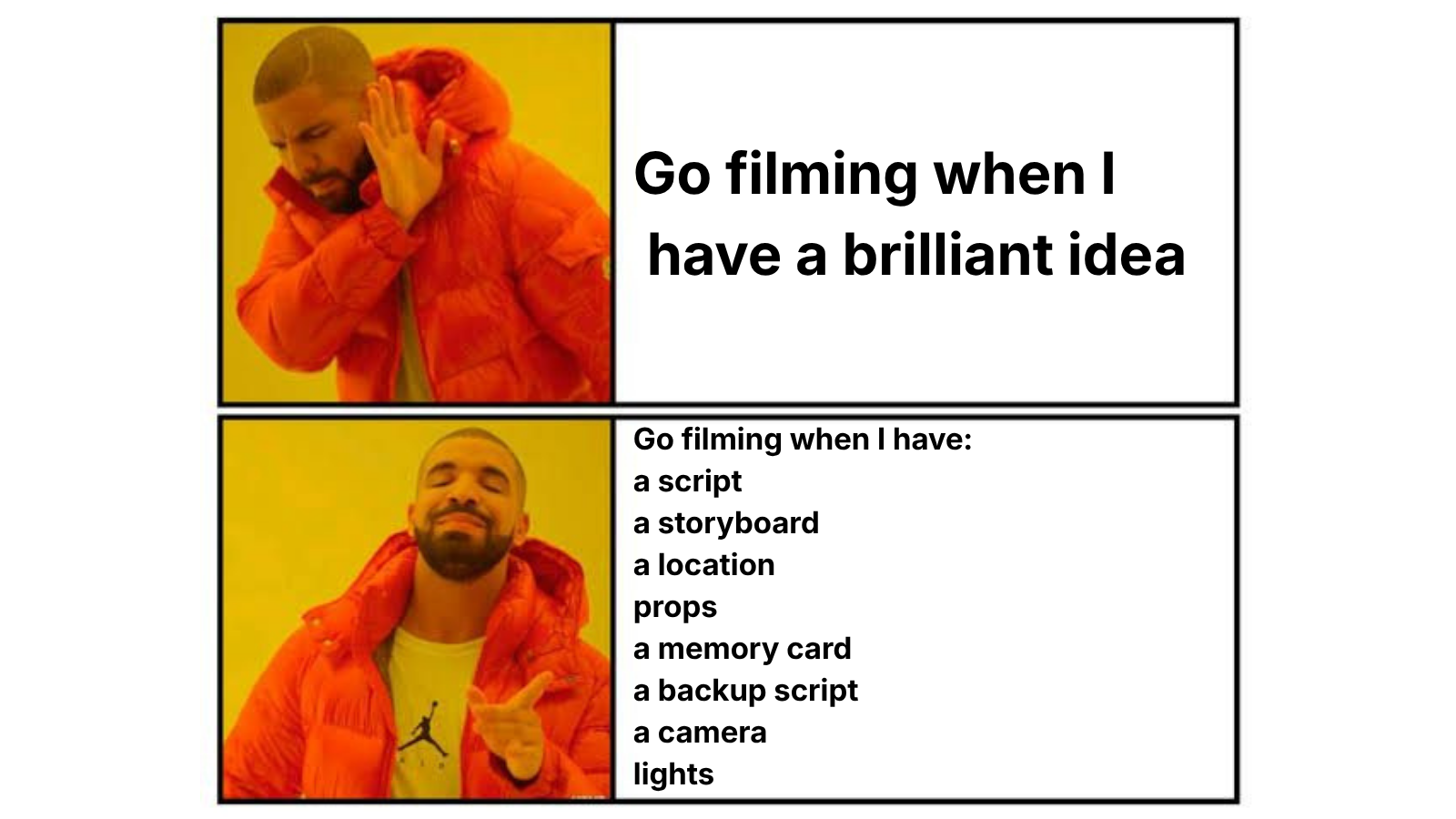
The most useful realization I had was slightly counterintuitive: filming becomes easier when preparation becomes the main work. I used to do the opposite, taking a vague idea and trying to build the video during the shoot. This is an excellent way to spend two hours doing something that should take one. Now, preparation takes about thirty minutes. Filming takes around an hour, sometimes two if I shoot multiple videos. Editing takes longer than both. But by the time I press record, the creative decisions are already made—and decisions are what make the process heavy.
There are also smaller, less philosophical improvements. For example, I now write a list before leaving the house: camera, lens, microphone, tripod, anything else I might need. This list exists for one reason—I prefer not to call my wife again to deliver missing equipment. It turns out that one minute of preparation is significantly more efficient than one hour of problem-solving.
Location used to be another hidden problem. I would go out and try to find something “interesting” on the spot. This sounds spontaneous; in practice, it is inefficient. Now I notice locations in advance—while walking, commuting, or doing something unrelated. When I need a place to film, it’s already decided. This removes another layer of unnecessary thinking.
Then there is the issue of complexity. Some ideas look very impressive in your head: multiple angles, transitions, perfect lighting. And then you try to film them. If a video feels too complicated, I simplify it—not slightly, but aggressively. Because a simple video that exists is infinitely more useful than a complex one that doesn’t.
Most beginners assume the difficulty comes from equipment or editing. It usually doesn’t. It comes from having no clear plan—no script, no structure, no idea what needs to be filmed. So everything has to be solved in real time, and the brain is not particularly enthusiastic about solving ten problems at once.
At some point, something became clear: creating content became easier the moment I understood that preparation is the most important part of the process. Not filming, not editing—preparation. Once the idea is clear, the script exists, and the location is chosen, the rest becomes predictable. You arrive, you set up, you press record.
This doesn’t make the process effortless, but it makes it repeatable. And repeatable processes are the only ones that survive long enough to produce results.
If filming currently feels like a space launch, the solution is not more motivation. It is fewer decisions, simpler ideas, better preparation, and a process you don’t have to rethink every time. Because consistency is not built on discipline—it is built on convenience.
Next time, we’ll talk about something slightly controversial:
why trying to be original often makes your content worse. Oh, I’ve been there too many times.
Consider this your warning.
Warmly,
AL.