
The most dangerous stage of being a creator
There is a very predictable moment in the life of many creators.
At first, everything is exciting.
The first video.
The first comments.
The quiet optimism that something interesting might happen if you keep going.
Then comes the second phase — which is less glamorous.
The videos are slightly better than before, but not good enough to impress anyone yet.
Views fluctuate in ways that feel suspiciously personal.
You begin to suspect the algorithm is offended by you.
This is the stage where most creators stop.
Curiously, it is also the stage where many of them were about to become good.
The reason is not a lack of talent.
It is a misunderstanding of how skill develops.
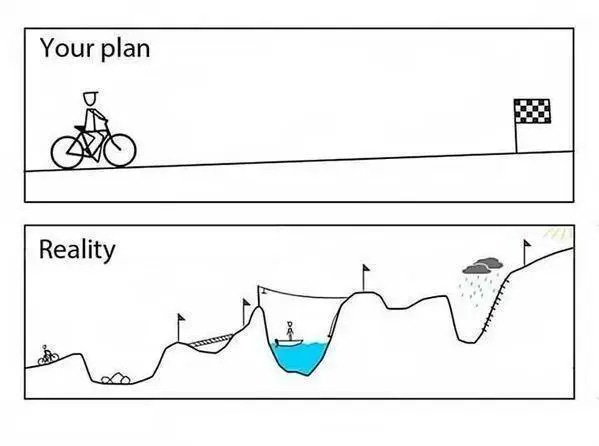
Most people imagine progress as a straight line: effort goes in, improvement appears immediately.
Reality behaves more like a delayed package.
You send work into the world for weeks or months without visible results. During this time your brain quietly accumulates experience: writing becomes clearer, editing becomes faster, your eye for detail sharpens.
Then one day something clicks.
Not dramatically. Just enough for other people to notice.
But that click only arrives if you stay long enough.
Popular writing about creative work often describes this as the “valley of disappointment.” It’s the stage where you’re better than a beginner but not yet interesting enough to attract attention.
Which makes it psychologically dangerous.
Because improvement is happening internally, while feedback from the outside world is still very quiet.
Another reason creators disappear here has less to do with creativity and more to do with psychology.
Many creators have a mind that behaves suspiciously like ADHD.
Not necessarily the clinical version — but the familiar pattern: enthusiasm at the beginning, intense focus for a short period, and then a sudden drop in interest once novelty disappears.
New projects are exciting.
Consistency is not.
The brain begins to search for the next exciting idea instead of finishing the current one.
The result is a graveyard of half-developed channels and abandoned concepts.
Ironically, the point where novelty fades is exactly where skill begins.
The first stage is curiosity.
The second stage is repetition.
The third stage is mastery.
Most people leave somewhere between stage one and two.
Then there is the quieter problem: impostor syndrome.
At some point, creators begin to notice that other people in their niche appear more confident, more polished, more established.
A small voice appears in the background saying:
“Who do you think you are to talk about this?”
This voice is surprisingly persuasive.
Even when the creator is objectively improving, the internal narrative becomes: “I’m not qualified yet.”
The irony is that the internet rarely rewards the most qualified person in the room.
It rewards the clearest one.
But impostor syndrome does not care about irony.
It cares about comfort.
And silence is very comfortable.

Which leads to an uncomfortable conclusion.
Most creators don’t stop because they fail.
They stop because they can’t see the progress that is already happening.
Skill develops slowly, invisibly, and often without applause.
By the time the outside world begins to notice, many people have already left the room.
The creators who remain are not always the most talented.
They are simply the ones who stayed slightly longer than their doubt suggested.
In other words, the difference between “almost good” and “good” is often just patience.
And patience, unfortunately, is the least glamorous creative skill.
Next time, we’ll talk about something much more practical:
how to design your filming process so creating content doesn’t feel like preparing for a space launch.
Consider this your warning.
Warmly,
AL.