Why trying to be original often makes your content worse?
There is a particular kind of idea every creator has at some point, and it usually arrives with great confidence. You are walking, or showering, or doing something unrelated, and suddenly it appears: this is it. Not just a good idea, but a truly original one. Clever, creative, slightly ahead of its time. You can already imagine the comments, the shares, the quiet admiration of strangers who will finally understand your brilliance.
So you film it. You edit it carefully. You post it. And then… nothing happens.
“The more original the idea feels in your head, the less the audience seems to care.”
Not even dramatic failure, which at least would be entertaining. Just silence. A few polite likes, most likely from people who know you personally and feel a certain obligation to support you. The internet, as it turns out, is not impressed.
This has happened to me more times than I would like to admit. Every time I tried to unlock something especially creative, especially original, especially clever, the result was remarkably consistent: low views, low engagement, and, if we are being honest, slightly lower self-esteem. It becomes a pattern. The more original the idea feels in your head, the less the audience seems to care about it.
At some point, I began to notice something mildly disturbing. Whenever I stopped trying to invent something brilliant and instead took an idea that was already working — and simply recreated it — the result was noticeably better. Not always, which would have been too convenient, but often enough to become uncomfortable. The views were higher. The engagement was stronger. The growth was visible.
Which creates a very specific emotional situation. On one hand, you are pleased. The numbers are improving, the progress is measurable, and the whole thing finally starts to look like it might work. On the other hand, you begin to suspect that you have accidentally become an impostor.
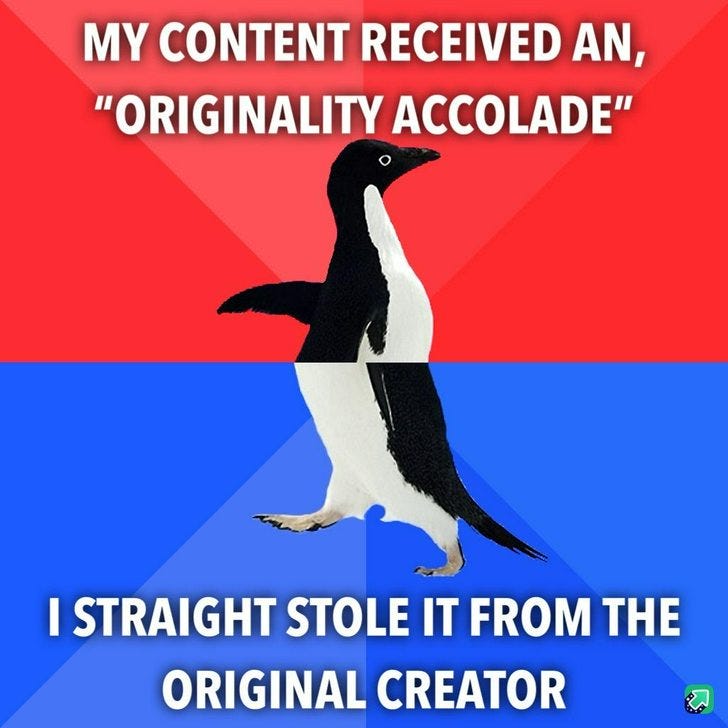
“If this works, is it actually mine?”
You start asking questions that are not particularly helpful: if this works, is it actually mine? And if my original ideas don’t work, should I even trust them?
The mistake here is assuming that originality is supposed to come first. It isn’t. Originality is usually what happens later, after you have spent enough time understanding what already works. When you are starting out, your job is not to invent entirely new formats. Your job is to recognize patterns. You look at a video that performs well, you understand why it works, and you recreate its structure. This is not as scandalous as it sounds. It is simply how most creative fields have always functioned.
Painters study other painters before they develop their own style. Writers imitate other writers long before they sound like themselves. Musicians play other people’s songs before they write anything worth listening to. The difference is that the internet made this process more visible, and therefore slightly more uncomfortable.
“Originality is not where you begin. It’s where you arrive.”
There is also a practical distinction that helps reduce the internal conflict. Not every piece of content has the same purpose. Some videos exist to attract attention. They bring people in, they generate reach, they make sure someone actually discovers you. Other videos exist to build trust. They show how you think, how you work, what you care about. The first type grows your audience. The second type keeps it.
If you try to make every video both highly original and highly effective at the same time, you will likely end up with something that satisfies neither requirement particularly well. It is far more useful to separate these roles. The videos you “borrow” — or, more politely, reinterpret — help you grow. The videos you build from your own perspective help you establish identity.
The idea that you must be completely original from the beginning is appealing, but also slightly unrealistic. To succeed purely on originality, you would need to be unusually creative, consistently productive, highly skilled, visually distinctive, and ideally supported by a team that helps you execute all of it. This is not impossible, but it is an ambitious expectation for someone trying to film a video after work.
A more practical approach is less romantic and more effective. You take something that already works. You recreate it. And then you adjust it. You make it clearer, sharper, more aligned with your taste. Over time, these small adjustments accumulate. And eventually, something interesting happens: what started as imitation begins to look like style.
Which brings us to the slightly uncomfortable conclusion. Trying too hard to be original often makes your content worse, not because originality is a bad goal, but because it is a late-stage outcome. It is not where you begin. It is where you arrive after you understand the rules well enough to break them intentionally.
Until then, the most reliable strategy is surprisingly simple. Observe what works. Recreate it. Improve it. Repeat. And occasionally allow yourself to make something completely original — not for the numbers, but for your own voice.
“Because growth brings people in. But trust is what makes them stay.”
Which brings us to the quiet conclusion that many creators discover sooner or later.
People who never seem to run out of ideas are not necessarily more creative.
They are simply more attentive.
They notice things.
They pay attention to moments that others ignore.
And when an idea appears — often briefly and without warning — they capture it before it disappears.
Inspiration rarely arrives while staring at a blank page.
It usually appears while you are busy living your life.
Your only responsibility is to notice it.
And, occasionally, to write it down before it escapes.
Next time, we’ll talk about something… something…well, I think I might leave it a secret topic, to elevate the suspense.
Consider this your warning.
Warmly,
AL.