

Nobody cries in orange
Last week we established that your eye has terrible taste — it snaps to whatever moves or stands out, meaning be damned.
Today, the second half of that story. Because once the eye lands somewhere, something else quietly takes over.
Colour.
It's the thing I get asked about most, so let's talk about what it actually does.
Colour is not decoration. Colour is emotion. Before anyone reads your caption or hears a word, the colour has already told them how to feel. Warm tones feel safe and close. Cold tones feel calm, or lonely, or far away. You feel a frame before you understand it.
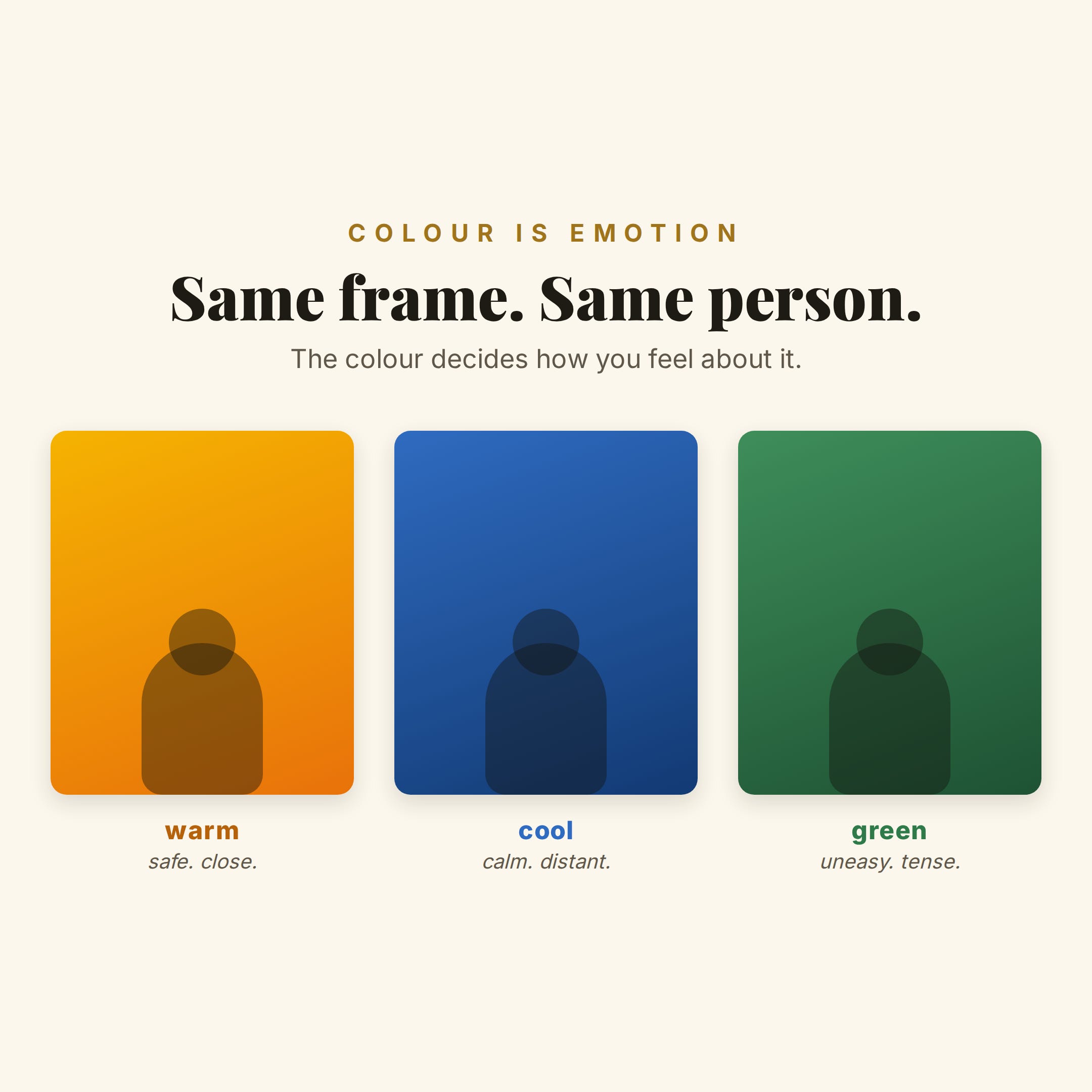
Here's the mistake almost everyone makes: they use colour like a label. Red means danger. Blue means sad. That's the most boring version of colour, because everyone already expects it.
The interesting part is that colour means whatever you decide it means.
If every calm moment in your videos is warm and gold, that becomes your calm. If your quiet moments are always cold blue, people start to feel it coming before anything happens. You're not decorating frames anymore — you're teaching your audience your own language.
So stop asking "what colour looks nice here?"
Start asking "what do I want them to feel here?" — then pick the colour that carries it.
That's where a real look comes from. Not a filter. A feeling you chose on purpose.
And the biggest colour decision isn't in your editing app
It's the temperature of your light. It quietly runs the whole mood, and most people never think about it once.
Warm light — the golden kind — feels safe, close, like a memory. Cool light — the blue kind — feels calm, or lonely, or a little cold. Same room. Same face. Change the temperature and you've changed how the moment feels before anything happens in it.
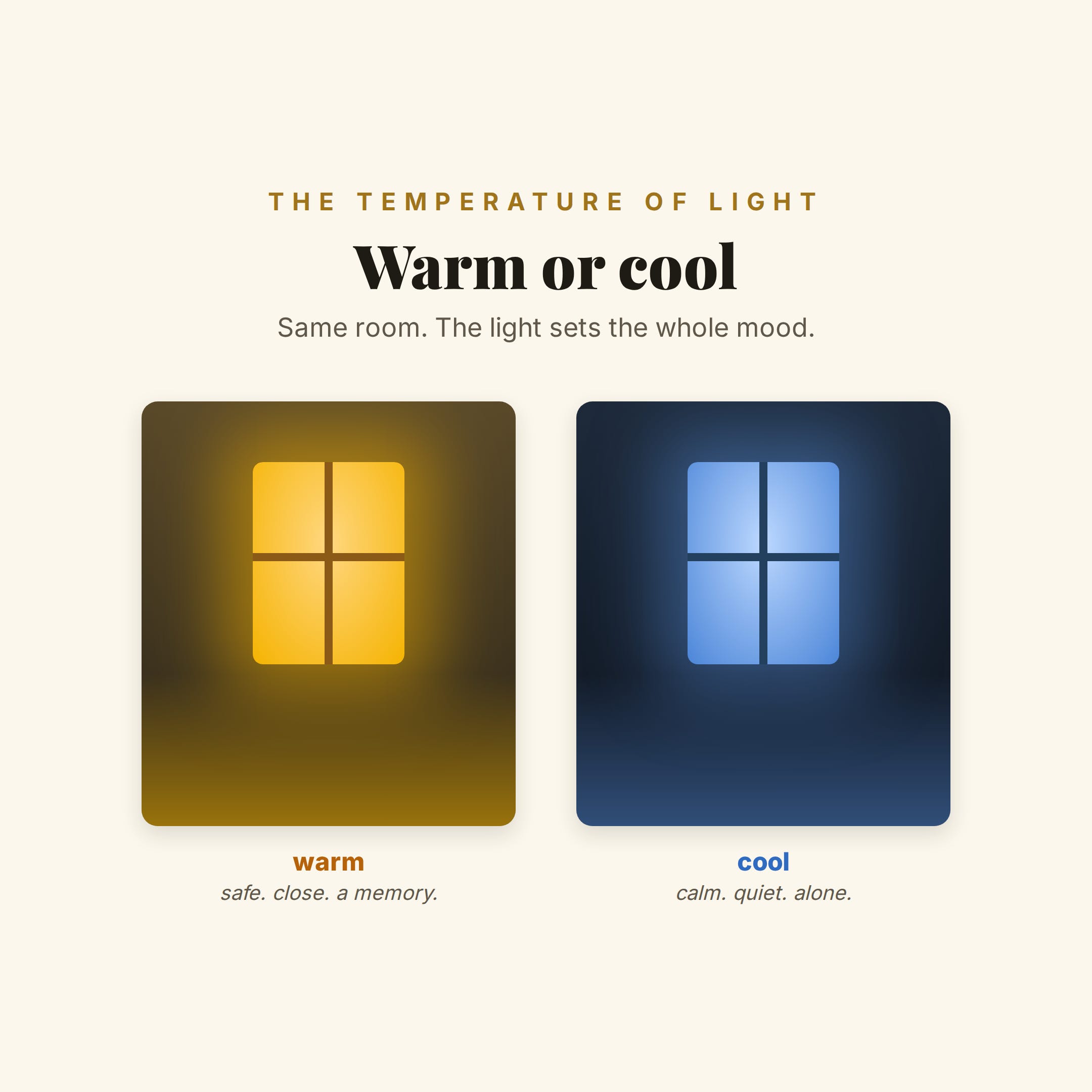
You already live with this, by the way. Morning sun through a window is warm. A phone screen in a dark room is cold. Streetlights at night are that orange hum.
Your eyes read those temperatures instantly — and so does everyone watching your videos.
Here's the useful part: pick the feeling first. If a moment should feel warm and human, lean into warm light and let it glow. If it should feel distant or quiet, let it go cool. Fighting the temperature is why a shot sometimes feels off even when you can't say why — the light is telling one story while the scene tells another.
(And yes — this is the same lesson from the color grading email, back again in a different hat. Light isn't one department of good video. It's most of them.)
Your homework this week doesn't even require a camera.
Just start noticing the temperature of light around you all day. The kitchen in the morning. The office at 3pm. The bar at midnight. Name each one — warm or cool — and notice what it does to the feeling of the room.
Then, tonight, open your last video and ask the harder question: what is the colour saying — and is it what the moment meant?
Once you feel the difference, you'll never light a shot by accident again.
Warmly, AL.

P.S. I want to hear the weirdest one you catch — the room where the light completely disagrees with the mood. Drop it in the comments. (And the bigger thing I keep hinting at? Colour has a whole chapter in it. That's all I'm saying for now.)